
Mini-Split vs. Central Air: Which Is Better for Your Home?
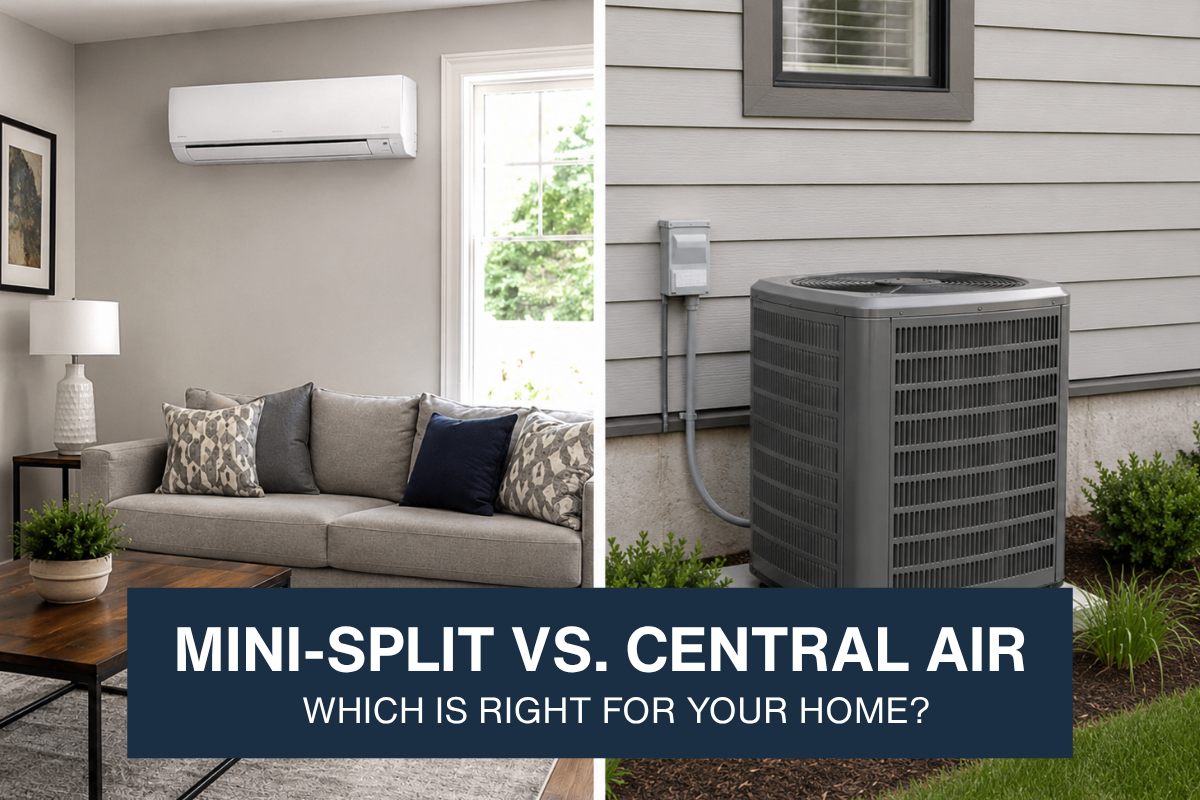
If you're comparing a mini-split vs. central air, the biggest difference is how each system delivers heating and cooling throughout the home.
A central air system uses ductwork to distribute conditioned air through supply registers. A ductless mini-split sends heating or cooling directly into individual rooms or zones using indoor units connected to outdoor equipment.
At Carmel Valley Heating & Sheet Metal, we install and service heat pumps and mini-splits throughout Monterey County. The better choice depends on your home's existing ductwork, layout, comfort needs, efficiency goals, and how you want different rooms to be controlled.
Mini-Split vs. Central Air: What's the Main Difference?
Central air is designed around a duct system.
An outdoor air conditioning or heat pump unit works with indoor equipment, and conditioned air is distributed through ducts to rooms throughout the home.
A mini-split is ductless. One outdoor unit connects to one or more indoor units, allowing individual rooms or zones to receive heating and cooling without relying on a conventional duct network.
ENERGY STAR notes that ductless mini-split systems can be useful in homes without existing ductwork and can provide zoned heating and cooling. Learn more from ENERGY STAR.
For many homeowners, the decision comes down to this:
Central air can be a strong fit when good ductwork already exists and whole-home conditioning is the goal
Mini-splits can be a strong fit when ductwork is unavailable, difficult to add, or when independent room control is important
Mini-Split vs. Central Air at a Glance
The right system depends on your home's ductwork, layout, comfort needs, and how much control you want over individual spaces.
| FEATURE | MINI-SPLIT | CENTRAL AIR |
|---|---|---|
| Air distribution | Individual indoor units | Ductwork and supply registers |
| Ductwork required | No | Yes |
| Temperature control | Individual rooms or zones | Usually centralized |
| Best suited for | Ductless homes, additions, and zoned spaces | Whole-home conditioning with existing ducts |
| Indoor appearance | Visible wall, floor, or ceiling units | Discreet supply and return registers |
| Good for additions | Often a strong option | Depends on whether existing ducts can serve the space |
| Efficiency considerations | Avoids traditional duct losses and allows zoning | Can be highly efficient with well-designed, sealed ducts |
Mini-splits offer flexibility and zoned comfort without ductwork. Central air can be a strong whole-home option when properly designed ductwork already exists.
When Does Central Air Make More Sense?
Central air can be a practical choice for homes that already have properly designed and maintained ductwork.
Instead of placing indoor units throughout the house, central systems distribute conditioned air through registers that are integrated into the home.
Central air may make more sense when:
Your home already has usable ductwork
You want one system serving most or all of the house
You prefer discreet supply registers
Most rooms have similar heating and cooling needs
Your existing central system is due for replacement
You want centralized thermostat control
Existing ducts should still be evaluated before installing new equipment.
Leaks, damaged sections, inadequate insulation, poor airflow, or incorrect duct sizing can reduce comfort and efficiency even when the new HVAC equipment itself is performing properly.
For homeowners with existing ducts, the condition of the air distribution system can be just as important as the equipment selected.
When Is a Mini-Split the Better Choice?
Mini-splits become especially useful when a home does not have ductwork or when adding new ducts would require significant construction.
That can make them a strong option for older homes, additions, converted garages, guest spaces, home offices, and other areas that are difficult to serve with an existing central system.
A mini-split may make more sense when:
Your home does not have ductwork
You want room-by-room or zone control
You are adding heating and cooling to an addition
One area of the home is consistently uncomfortable
New ductwork would be difficult or disruptive to install
You want to condition only selected spaces
Your home has an unusual layout
Mini-splits can also be used in multi-zone configurations, with several indoor units connected to outdoor equipment.
If you are comparing ducted and ductless heat pump systems more broadly, our guide to heat pumps vs. mini-splits explains those differences in more detail.
Which Is More Efficient: Mini-Split or Central Air?
There is no universal answer.
Mini-splits can avoid energy losses associated with ductwork because conditioned air is delivered directly into the room. This can be especially useful in homes where existing ducts would otherwise run through attics, crawl spaces, or other areas where air leakage and heat transfer can occur.
Mini-splits also allow zoning. Instead of conditioning the entire home to one thermostat setting, homeowners may be able to adjust individual areas based on how those spaces are being used.
Central air can also operate efficiently when the equipment is properly sized and the ductwork is well designed, sealed, and insulated.
Efficiency depends on more than the system type.
Important factors include:
Equipment efficiency ratings
System sizing
Installation quality
Duct condition
Insulation
Windows
Air leakage
Sun exposure
Home layout
Thermostat settings
How the household actually uses the system
Choosing a mini-split does not automatically guarantee lower energy use, and choosing central air does not automatically mean higher energy use.
The system needs to fit the property.
How Does Zoning Compare?
Zoning is one of the biggest practical differences between mini-splits and traditional central air.
A standard central system usually responds to one thermostat or a limited number of zones. When the thermostat calls for cooling, the system distributes conditioned air through the home's ductwork.
Mini-splits are naturally suited to zoning because individual indoor units can serve different rooms or areas.
That can be helpful when:
Bedrooms are used mostly at night
A home office needs different temperatures during the day
An addition heats or cools differently from the original house
Guest rooms are only used occasionally
Upper and lower floors have different comfort needs
Zoning can improve comfort because the entire house does not have to operate around the temperature of one centrally located thermostat.
However, system design still matters. Adding more indoor units than necessary is not automatically better. Each zone should be sized and located according to the room or area's actual heating and cooling needs.
What About Installation?
Installation can look very different depending on the home.
If a house already has usable ductwork, installing or replacing a central system may be relatively straightforward compared with adding an entirely new air distribution network.
If there is no ductwork, central air can require significant construction.
Ducts may need to be routed through:
Attics
Crawl spaces
Ceilings
Walls
Closets
Other concealed areas
This can be particularly challenging in older homes or properties with architectural details homeowners want to preserve.
Mini-splits do not require this type of duct network.
Indoor units connect to outdoor equipment using refrigerant lines, electrical connections, and condensate drainage.
The installation is not necessarily simple, though. Equipment capacity, indoor-unit location, line routing, drainage, electrical requirements, outdoor-unit placement, and manufacturer clearances all need to be planned carefully.
Which System Looks Better Indoors?
Appearance matters to many homeowners.
Central air has the advantage of being visually discreet inside the home. Most of the equipment and ductwork are concealed, leaving only supply and return registers visible.
Traditional mini-split systems often use wall-mounted indoor units, which are more noticeable.
However, ductless equipment is not limited to one indoor-unit style. Depending on the system and application, indoor units may be available in wall-mounted, floor-mounted, or ceiling-mounted configurations.
The better choice depends partly on the architecture of the home and the homeowner's preferences.
For some older properties, avoiding major construction for ductwork is more important than hiding the indoor equipment. In other homes, preserving a clean interior appearance may favor a ducted system.
Mini-Splits Can Be Useful for Older Monterey County Homes
Many Monterey County homes were built before modern central air conditioning became common.
Older homes may have:
No existing ductwork
Limited attic or crawl-space access
Additions completed at different times
Thick walls or unusual framing
Architectural details worth preserving
Rooms that do not share the same comfort needs
Adding a full duct network to one of these homes can be a much larger project than simply selecting new HVAC equipment.
A mini-split can provide heating and cooling without requiring conventional ducts to be installed throughout the property.
That does not mean ductless is automatically the best option for every older home.
If useful ductwork already exists or the property is undergoing a larger renovation where duct installation is practical, central air may still make sense.
How Do Coastal Conditions Affect the Decision?
Monterey County also has environmental conditions that are worth considering when selecting HVAC equipment.
Homes near Carmel-by-the-Sea, Pebble Beach, Monterey, Pacific Grove, and other coastal communities can experience marine air, fog, moisture, and salt exposure.
Outdoor HVAC equipment in those environments may face more corrosive conditions over time, making equipment placement and ongoing HVAC maintenance especially important.
Both central air and mini-split systems have outdoor equipment, so coastal exposure is not unique to one system type.
The exact location of the outdoor unit, airflow, drainage, prevailing winds, landscaping, and access for maintenance can all matter.
If coastal conditions are an important part of your decision, our guide to the best HVAC systems for coastal homes covers those considerations in more detail.
Can a Mini-Split Cool an Entire House?
Yes, depending on the home and system design.
A multi-zone mini-split system can connect several indoor units to outdoor equipment, allowing multiple areas of the home to be conditioned.
However, whole-home ductless design requires more planning than simply putting one indoor unit in each room.
A contractor should consider:
Room size
Floor plan
Insulation
Windows
Sun exposure
Ceiling height
Occupancy
Air movement between rooms
Equipment capacity
Indoor-unit placement
Some homes are excellent candidates for whole-home ductless systems. Others may be better served by central air or a combination of central and ductless equipment.
Can You Use Central Air and Mini-Splits Together?
Yes.
A home does not always have to choose one system type exclusively.
For example, a central HVAC system may serve the main portion of the home while a mini-split handles:
A new addition
Converted garage
Guest suite
Home office
Bonus room
Upper floor
Detached space
This type of hybrid approach can solve comfort problems without requiring the entire HVAC system to be redesigned.
It can also be useful when the existing ductwork does not effectively serve one particular part of the home.
Which System Fits Your Home?
Your existing HVAC setup and how you use your home can help narrow down whether mini-splits or central air make more sense.
| IF YOUR HOME... | CONSIDER... |
|---|---|
| Already has good ductwork | Central air may provide a straightforward whole-home solution |
| Has no existing ductwork | A mini-split can provide heating and cooling without adding a duct network |
| Has an addition or converted space | A mini-split can condition the area independently |
| Needs room-by-room temperature control | Mini-split zoning may provide greater flexibility |
| Needs consistent whole-home conditioning | Central air can work well when the duct system serves the home effectively |
| Has one room that is always uncomfortable | A supplemental mini-split may solve the problem without replacing the central system |
| Is an older home with limited space for ducts | A mini-split may avoid major changes to walls, ceilings, or architectural details |
You do not always have to choose one system for the entire property. Some homes can use central HVAC for the main living areas and a mini-split for additions or difficult-to-condition spaces.
Which Costs More: Mini-Split or Central Air?
The answer depends heavily on the scope of the project.
If good ductwork already exists, a central air replacement may involve less construction than installing a whole-home multi-zone mini-split system.
If the home does not have ducts, adding a new central air system can become more complex because the cost may include not only the HVAC equipment but also a new duct network.
Mini-split pricing can also vary substantially depending on:
Number of indoor units
Number of zones
Equipment capacity
Installation locations
Refrigerant line lengths
Electrical work
Controls
Access
The right comparison is therefore not simply the price of one outdoor unit versus another.
Homeowners should compare complete installation scopes.
Our guide to heat pump costs in California explains several of the factors that can affect HVAC project pricing.
Which Is Better for a Monterey County Home?
For homeowners comparing a mini-split vs. central air, neither system is automatically better.
A central system can be a strong choice when:
Good ductwork already exists
Whole-home conditioning is the goal
You prefer concealed indoor equipment
Centralized temperature control works well for the property
A mini-split can be a strong choice when:
The home has no ducts
You need independent comfort zones
You are conditioning an addition or individual space
Adding ducts would be disruptive
Different rooms have different comfort needs
The home's construction and location matter just as much as the technology.
A coastal cottage in Carmel-by-the-Sea without ductwork presents a different HVAC decision from a newer Carmel Valley home with a complete central air distribution system.
Choose the System That Fits the Home
When comparing mini-split vs. central air, the best choice comes down to how the home is built and how you want it to operate.
Central air offers familiar whole-home distribution and discreet supply registers when suitable ductwork is available. Mini-splits provide flexibility, zoning, and an alternative for homes where installing ducts would be difficult or unnecessary.
Efficiency, installation complexity, appearance, coastal exposure, equipment placement, and the number of spaces being conditioned should all be considered together.
Carmel Valley Heating & Sheet Metal works with homeowners throughout Monterey County to evaluate existing HVAC systems and determine which heating and cooling approach makes sense for the property.
Considering central air or a mini-split? Contact Carmel Valley Heating & Sheet Metal or call (831) 298-9922 to discuss your home and HVAC options.
Frequently Asked Questions About Mini-Splits and Central Air
Is a mini-split better than central air?
It depends on the home. Mini-splits can be especially useful for properties without ductwork, additions, and rooms that need independent temperature control. Central air can be a strong fit for whole-home comfort when properly designed ductwork already exists.
Are mini-splits more efficient than central air?
Mini-splits can avoid energy losses associated with ductwork and allow zoned temperature control. Central air can also operate efficiently when the equipment is properly sized and the ducts are sealed, insulated, and appropriately designed.
Can a mini-split cool a whole house?
Yes. Multi-zone mini-split systems can provide heating and cooling to multiple areas of a home. Whole-home design should account for room size, layout, insulation, windows, equipment capacity, and indoor-unit placement.
Is central air cheaper than a mini-split?
It depends on the installation. Central air may be less complicated when usable ductwork already exists. In a home without ducts, adding central air can require significant additional construction. Multi-zone mini-split systems can also become more expensive as additional indoor units are added.
Do mini-splits need ductwork?
No. Ductless mini-splits deliver conditioned air directly through indoor units and do not require a conventional duct network.
Can I add a mini-split if I already have central air?
Yes. Mini-splits can supplement central HVAC in additions, home offices, guest rooms, converted garages, or other areas the existing duct system does not serve effectively.
Are mini-splits good for older homes?
They can be. Mini-splits are often useful in older homes that lack ductwork or where adding ducts would require significant changes to ceilings, walls, or architectural features.
Which system is better for coastal Monterey County homes?
Either can work well when properly designed and installed. The best choice depends on existing ductwork, home layout, comfort needs, coastal exposure, equipment placement, and how much zoning the homeowner wants.
Ready to Find the Right HVAC System for Your Home?
Every home has different heating and cooling needs. Carmel Valley Heating & Sheet Metal can evaluate your property, existing ductwork, comfort priorities, and system goals to help determine whether central air or a ductless mini-split is the better fit.